

Every section picks its own pairing method — the rule for who plays whom each round. You set it when you add the section, and different sections in the same event can use different methods (a Swiss Open next to a knockout blitz side event is no problem). This guide walks through each one: what it’s good for, and how it runs.
Swiss — the default
Players are paired by score: after each round, winners meet winners and everyone plays the same number of rounds, whether you have 12 players or 200. Nobody is eliminated, so a player who loses early still gets a full event. The engine handles colors, avoids rematches, and follows the USCF rules — you review and post.
Reach for it when: you have a medium-to-large field and a fixed number of rounds. It’s the workhorse for weekend opens and scholastics.
Double Swiss
A Swiss where each pairing is a two-game match — the same two players meet twice, once with each color, before the standings re-sort. You get more games per opponent (and steadier ratings) out of a smaller field, and it supports team sections and accelerated pairings.
Reach for it when: the field is smaller and you’d rather players get two games against each opponent than face twice as many different people.
Round Robin & Double Round Robin
Everybody plays everybody. A round robin is one game against each opponent; a double round robin is two — once with each color. The whole schedule is fixed up front, so instead of pairing by standings you’re just publishing the next set of boards and scoring them. It’s the fairest format there is, because every player faces the identical field.
Reach for it when: the section is small (round robins get long fast — a 10-player section is 9 rounds) and you want maximum fairness, like a championship or an invitational.
Quads
Players are grouped into quads — sets of four by rating — and each quad plays a three-round round robin among itself. A scholastic staple: quick, everyone gets three rated games against players near their level, and a big room resolves in an afternoon.
Reach for it when: you’re running a scholastic or a rated club night and want tight, close-in-rating groups without a long Swiss.
Knockout (single-elimination)
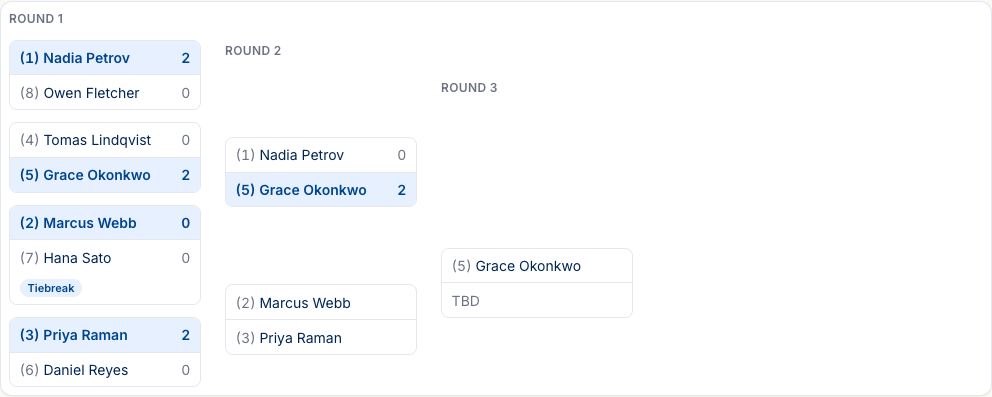
A bracket. Winners advance, losers are out, and the last player standing is the champion. This is the format with the most moving parts, so here’s how it works in Rook Ready.
- Seeding. Players are seeded by rating into a standard bracket, with byes going to the top seeds when the field isn’t a power of two — so the strongest players get the round-1 pass.
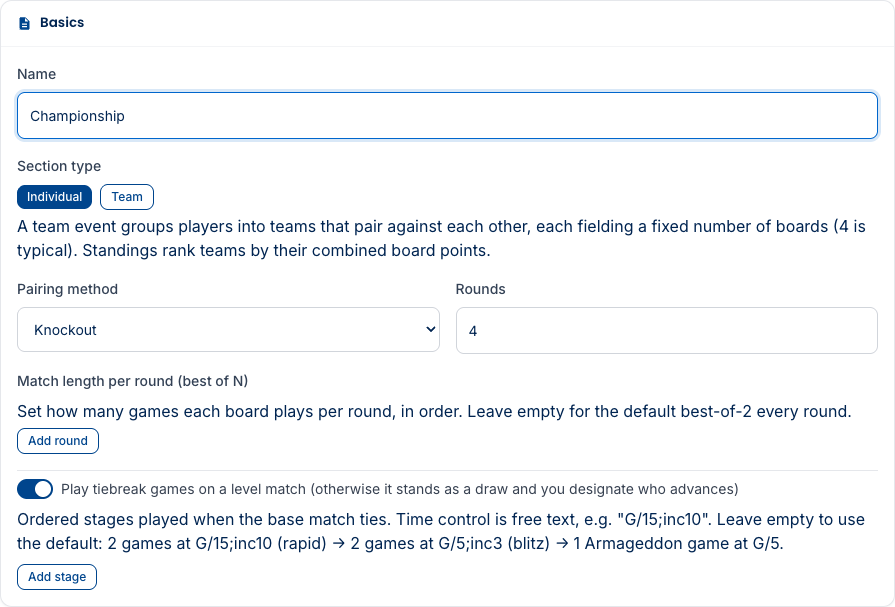
- Matches, not single games. Each board is a best-of-N match (best-of-2 by default; you can set a different length per round). A player advances when they clinch the match.
- Tiebreak games. If a match ends level and you leave the tiebreak ladder on, Rook automatically plays the next stage — by default two rapid games, then two blitz, then a single Armageddon game where the higher seed takes Black with draw-odds (a draw advances them). Each stage has its own time control, which you can customize. Prefer to decide level matches yourself? Turn the ladder off, and a tied match shows a Who advances? control instead.
- The Bracket tab. The whole event lives on a bracket view — seeds, scores, who’s advanced, byes, tiebreak badges, and the champion once the final is in. It’s live for you in the director workspace and for spectators on the public section page.
Which should I pick?
- Big open field, everyone plays every round → Swiss.
- Smaller field, want two games per opponent → Double Swiss.
- Small section, maximum fairness → Round Robin (or Double for the very small).
- Scholastic, tight rating groups, done in an afternoon → Quads.
- A bracket with a single champion → Knockout.
And you’re not locked in across the event — one section can be a Swiss Open while another is a knockout, each running its own way.
What’s next
- Set up a tournament — where you choose the format and add your sections.
- Run your event, round by round — pairing, scoring, and the format-specific bits in action.
Questions? The FAQ and support@rookready.com are here for you.
Updated July 13, 2026